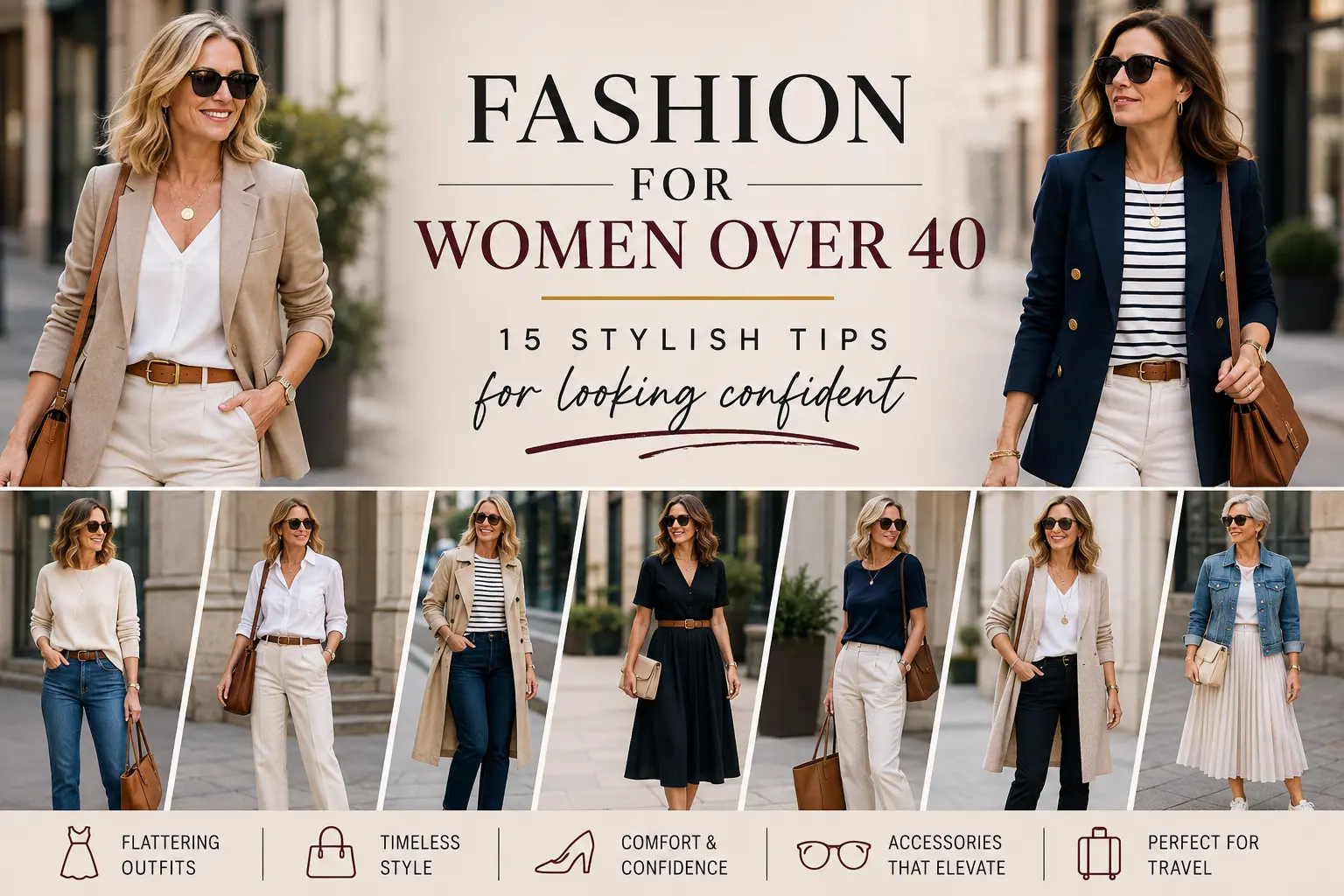
Fashion for women over 40 is about choosing clothes that suit your lifestyle, your body, and your taste — not about following age-based rules. Focus on flattering proportions, good fabrics, versatile basics, comfortable shoes, and accessories that keep an outfit feeling current, without trying to dress like someone you’re not.
Table of Contents
- What Does Fashion for Women Over 40 Really Mean?
- Build Your Style Around Fit, Not Age
- Start With a Strong Wardrobe Foundation
- Choose Fabrics That Look and Feel Good
- Learn How to Balance Proportions
- Don’t Be Afraid of Color
- Find Jeans That Actually Fit
- Dresses for Women Over 40: Styles That Actually Work
- Casual Outfits for Women Over 40: How to Look Polished
- Dress Stylishly for Work
- Use Accessories to Change an Outfit
- Choose Shoes for Style and Real Life
- Travel Outfits for Women Over 40: Comfort Meets Style
- Don’t Let “Age-Appropriate” Rules Limit You
- Common Fashion Mistakes to Avoid
- How to Build Your Personal Style After 40
- Final Takeaway
- FAQs
What Does Fashion for Women Over 40 Really Mean?
There’s no single “right” way to dress once you hit 40 — and that’s probably the first rule worth throwing out.
Fashion for women over 40 should reflect who you are now, not what someone else imagines a 40-, 45-, or 50-year-old is supposed to look like.
Your lifestyle matters. So does comfort. Maybe your wardrobe needs a bit more polish for work than it did ten years ago. Maybe you’re traveling more these days. Or maybe you’re just tired of clothes that look great in a photo but don’t actually work for your everyday life.
None of this means giving up on trends. It just means being selective — picking the ones that fit naturally into what you already own and how you already dress.
A structured blazer, a good pair of straight-leg jeans, a well-cut midi dress, leather loafers, a nice handbag, or a simple blouse can pull together a polished look without ever feeling overdone.
And if bold prints, bright colors, sneakers, denim, or statement jewelry are more your style — keep wearing them. Age doesn’t have to define your personality.
1. Build Your Style Around Fit, Not Age
One of the biggest upgrades you can make to your wardrobe after 40 has nothing to do with trends — it’s fit.
A $30 shirt that actually fits well will always look better than an expensive one that pulls across the shoulders or hangs loose at the waist.
Next time you’re shopping, check a few things:
- Does the shoulder seam sit where your shoulder actually is?
- Can you move your arms freely?
- Does the waistband stay flat when you sit down?
- Does the fabric pull tight across the bust?
- Do the trousers bunch up around your ankles?
- Does the garment hang naturally, without you needing to keep adjusting it?
A useful fitting trick: sit down before deciding whether trousers, jeans, or a dress really fit. Standing in front of a mirror only tells half the story — if a waistband digs in the moment you sit, it wasn’t as comfortable as it looked. Same goes for a blazer that feels great with your arms down but turns restrictive the moment you reach forward.
2. Start With a Strong Wardrobe Foundation
Before chasing the latest trend, it helps to build around pieces you’ll actually wear.
| Wardrobe Essential | Why It Works |
|---|---|
| Straight-leg or wide-leg jeans | Easy to dress up or down |
| Tailored blazer | Adds structure to simple outfits |
| Neutral trousers | Works for both office and smart-casual |
| White or neutral shirt | Wears well across seasons |
| Midi dress | Versatile for day and evening |
| Lightweight cardigan | An easy layering piece |
| Comfortable loafers | Polished without being too formal |
| Clean sneakers | Great for casual days and travel |
| Structured handbag | Instantly finishes an outfit |
| Simple jewelry | Adds personality, no fuss |
You don’t need all of these at once. The point isn’t to collect clothes — it’s to build combinations. Twenty-five pieces that actually work together will always beat a closet full of items that only pair with one specific outfit.
3. Choose Fabrics That Look and Feel Good
Fabric changes everything about how an outfit looks and wears. For everyday fashion after 40, pay attention to structure, drape, weight, and breathability.
- Cotton — great for shirts, tees, casual dresses, and warm-weather pieces.
- Linen — light and breathable, ideal for heat. It wrinkles easily, but that’s just part of its charm.
- Wool — reliable for sweaters, coats, trousers, and cold-weather layering.
- Cashmere — soft and light, though it needs a bit more care when washing and storing.
- Denim — a wardrobe staple, but weight and stretch can make or break the fit.
- Silk — elegant and lightweight, perfect for blouses, scarves, and occasion wear.
Don’t assume a pricier fabric is automatically the better choice — think about what the garment actually needs to do first.
4. Learn How to Balance Proportions
This is one of the simplest styling tricks you can start using right away.
If you’re wearing something loose or oversized on top, balance it with a cleaner line on the bottom:
- Oversized blazer + straight-leg jeans
- Relaxed sweater + streamlined trousers
Or flip it around:
- Fitted top + wide-leg trousers
No outfit has to be fitted from head to toe. It’s really about understanding how volumes play off each other.
Try the one-volume rule: if one part of your outfit is noticeably oversized, let another part bring in some structure — a tucked shirt, a defined waistband, a cropped jacket, or a straight-leg trouser can all do the job without feeling tight.
5. Don’t Be Afraid of Color
A common assumption about fashion after 40 is that it means switching everything to beige, navy, black, and gray. It doesn’t have to.
If you love red, emerald green, cobalt, pink, orange, or purple — wear them.
Not ready to commit to a full colorful dress? Start small:
- a colorful handbag
- a scarf
- statement earrings
- colorful shoes
- a bright cardigan
- a printed blouse
Try the three-color approach: if you’re unsure how to combine colors, keep an outfit to roughly three main tones — cream, denim, and burgundy; black, white, and red; or navy, white, and tan. It’s not a strict rule, just an easy place to start.
6. Find Jeans That Actually Fit
Jeans deserve their own section, because the right pair can end up doing more work than almost anything else in your closet.
Don’t pick a style just because it’s trending. Think about:
- rise
- leg shape
- stretch
- waistband
- length
- denim weight
- pocket placement
- what shoes you’ll actually wear them with
- Straight-leg jeans — an easy everyday choice that works with sneakers, loafers, or boots.
- Wide-leg jeans — more room through the leg, with a modern silhouette.
- Bootcut jeans — pairs especially well with boots or a small heel.
- Dark-wash denim — an easy way to make jeans feel a little more polished.
The best pair isn’t the trendiest one — it’s the one you can wear for hours without constantly tugging at the waistband.
7. Dresses for Women Over 40: Styles That Actually Work
When picking dresses, think about where you’ll actually wear them. A stunning dress that only suits one occasion isn’t necessarily a smart investment.
- Midi dresses — versatile for work, lunches, casual outings, and holidays.
- Wrap dresses — define the waist while staying comfortable.
- Shirt dresses — dress up with heels, dress down with sneakers.
- A-line dresses — a classic shape that adapts to different settings.
- Knit dresses — comfortable, but pay attention to fabric weight and how it sits on the body.
Ask yourself the practical questions: Can you sit comfortably in it? Does the neckline suit the occasion? Can you layer a jacket over it? Can you style it with different shoes? Those questions matter far more than whether a dress is labeled “age-appropriate.”
8. Casual Outfits for Women Over 40: How to Look Polished
Casual doesn’t have to mean careless. One of the simplest tricks is pairing comfort with a single polished element.
- Jeans + T-shirt + blazer + sneakers
- Wide-leg trousers + fitted knit + loafers
- Midi skirt + simple sweater + ankle boots
That polished element could be a structured bag, a blazer, leather shoes, a belt, good knitwear, or simple jewelry. You don’t need to dress formally to look put together — you just need a bit of contrast.
9. Dress Stylishly for Work
Workwear varies a lot depending on your industry, so there’s no single formula. A corporate office may call for tailored trousers and structured jackets; a creative workplace may leave more room for denim, prints, and relaxed silhouettes.
For a polished professional look, mix and match: tailored trousers, blouses, knit tops, blazers, midi skirts, loafers, simple pumps, and structured bags.
Try the “one relaxed piece” approach: if you’re wearing a formal blazer and tailored trousers, pair them with a simple T-shirt or clean sneakers where your workplace allows it. If your trousers and shoes are already casual, add a structured jacket instead. That small contrast makes an outfit feel current rather than stiff.
10. Use Accessories to Change an Outfit
Accessories are one of the fastest ways to refresh your wardrobe without buying anything new. The same black dress can look completely different with a leather belt, statement earrings, a silk scarf, a structured bag, or a bold necklace.
This is also where personal style really shows. Someone who loves minimalism might reach for a small watch and a leather bag; someone else might prefer large earrings and colorful shoes. Neither is more “correct” than the other.
Don’t underestimate belts — they can add shape to a loose dress, cardigan, blazer, or oversized shirt. Try a few different widths rather than assuming one style suits every outfit.
11. Choose Shoes for Style and Real Life
Shoes can make or break an outfit, but comfort and style don’t have to be a trade-off.
For everyday wear, it helps to have a mix of clean sneakers, loafers, ankle boots, ballet flats, low block heels, sandals, and one or two occasion pairs.
Before buying, walk around in them. Try them with the trousers, jeans, or dress you actually plan to wear. Check if your heel slips, if your toes have room, and if the sole holds up for how much walking you normally do — this matters even more when you’re planning travel outfits.
12. Travel Outfits for Women Over 40: Comfort Meets Style
Travel is where style and practicality really need to work together. An outfit might look great in a photo, but a six-hour flight, an airport walk, or a day exploring a new city changes what actually matters.
A practical travel outfit could look like:
- Stretch trousers + breathable top + lightweight jacket + comfortable sneakers + crossbody bag
For warmer destinations:
- Loose trousers + cotton or linen top + lightweight cardigan + walking sandals
For cooler destinations:
- Straight-leg jeans + knit sweater + coat + comfortable boots
Think in layers — airports, planes, restaurants, and outdoor sights can all sit at very different temperatures. If you’re also thinking about gear for the trip itself, see our guide to Nobl Travel Carry-On Luggage for pieces that pair naturally with this kind of travel-fashion look.
13. Don’t Let “Age-Appropriate” Rules Limit You
This is worth saying plainly: there’s no official list of clothes women over 40 aren’t allowed to wear.
Fashion changes. So do people. Recent coverage has leaned more toward representing women of all ages rather than treating youth as the only style reference point — fashion authority Who What Wear reported on designers casting women over 40 on major 2026 runways, and AARP’s style guide for women over 50 pushes back on rigid “rules” in favor of practical, personal style advice.
So if you love jeans, leather jackets, sneakers, mini skirts, bold colors, statement jewelry, graphic tees, or oversized clothing — you don’t have to give any of it up at 40. Instead, ask yourself:
- Does this fit well?
- Am I comfortable wearing it?
- Does it suit the occasion?
- Can I style it in a way that feels like me?
Those questions will serve you far better than any age-based rule.
14. Common Fashion Mistakes to Avoid
- Buying clothes only because they’re trendy. Ask whether you’ll realistically wear it more than a couple of times.
- Skipping alterations. Sometimes the best fix isn’t a new outfit — it’s the same garment with a better fit. A hem, a sleeve, a nipped-in waist can change everything.
- Choosing uncomfortable shoes. If you can’t walk in them comfortably, you probably won’t enjoy wearing them.
- Overloading on statement pieces. They’re fun, but they need basics to lean on.
- Wearing the wrong undergarments. The foundation of an outfit matters — match it to the fabric, cut, and neckline.
- Dressing for someone else’s idea of your age. This is probably the biggest one. Your wardrobe should reflect your actual life and personality, not anyone else’s expectations.
15. How to Build Your Personal Style After 40
If your wardrobe feels out of sync with who you are now, you don’t need to replace everything at once. Start with a simple audit:
Step 1 — Remove what doesn’t fit. If something’s uncomfortable, damaged, or constantly ignored, ask yourself why it’s still there.
Step 2 — Identify your most-worn pieces. Look at what you actually reach for — jeans and knitwear, dresses and boots, trousers and blazers. Those choices are clues to your real style.
Step 3 — Pick three style words. Try summing up your ideal wardrobe in three words: Classic, Comfortable, Modern. Or Minimal, Colorful, Relaxed. Or Elegant, Practical, Feminine. Use those words as a filter when you shop.
Step 4 — Shop around your existing wardrobe. Before buying a new top, ask: what three things can I wear this with? If the answer is “nothing,” leave it on the rack.
Step 5 — Add trends selectively. You don’t need a whole new wardrobe every season. One new bag, jacket, pair of shoes, or updated silhouette can refresh several outfits you already own.
A Simple Capsule Wardrobe for Women Over 40
| Category | Suggested Pieces |
|---|---|
| Tops | 2–3 neutral tops + 1–2 statement tops |
| Bottoms | 2 jeans + 2 trousers |
| Dresses | 2 versatile dresses |
| Layering | 1 blazer + 1 cardigan + 1 jacket |
| Shoes | Sneakers + loafers + boots + occasion shoes |
| Accessories | Everyday handbag + belt + scarf + simple jewelry |
You don’t have to hit these numbers exactly — the goal is a wardrobe where pieces mix and match, not sit isolated in the closet.
What Should You Spend More Money On?
Not everything deserves a big budget. A good rule of thumb is cost-per-wear: if you’ll wear something two or three times a week, it’s worth investing in better construction. For occasion pieces you’ll only wear once or twice, renting or buying secondhand often makes more sense.
Good candidates for a bigger budget: everyday shoes, coats, handbags you use often, jeans that fit exceptionally well, blazers, and quality knitwear. But a higher price tag doesn’t automatically mean better quality — check the stitching, fabric, lining, hardware, and fit for yourself.
How to Look Modern Without Chasing Every Trend
The easiest approach is updating your silhouette, not your whole personality. If you’ve always worn skinny jeans, you don’t need to throw them out — just try a straight or wide-leg pair now and then. If your blazers are all traditional, experiment with a slightly relaxed cut. If your wardrobe leans entirely neutral, add one current color.
Small changes can make familiar clothes feel new again — and when a trend catches your eye, adapt it to fit your existing style rather than rebuilding your closet from scratch.
Frequently Asked Questions
What is the best fashion for women over 40? The best fashion for women over 40 is whatever fits well, suits your lifestyle, feels comfortable, and reflects who you are. A versatile wardrobe of solid basics, mixed with a few trends you genuinely like, will usually give you more to work with than any strict age-based rule.
What should a 40-year-old woman wear to look stylish? Pretty much anything that suits her style and the occasion. Straight-leg jeans, tailored trousers, blazers, midi dresses, good knitwear, sneakers, loafers, and statement accessories are all versatile starting points — but personal taste should always have the final say.
What are good casual outfits for women over 40? Casual outfits work best when comfort meets one polished element — jeans with a blazer and sneakers, wide-leg trousers with a fitted knit and loafers, or a midi dress with a denim jacket and comfortable shoes.
Are there clothes women over 40 should avoid? Not really. Fit, comfort, occasion, and personal taste matter far more than age. If something doesn’t feel right or doesn’t suit your life, that’s a better reason to skip it than any age-based rule.
How can I make an older wardrobe look more modern? Update one or two elements at a time rather than replacing everything — a newer trouser cut, modern sneakers, a structured bag, updated jewelry, or a different jacket shape. Mixing a few current pieces into your existing wardrobe goes a long way.
Final Takeaway
Good fashion for women over 40 isn’t about following a rulebook — it’s about knowing what actually works for you.
Start with fit. Then think about fabric, proportion, color, comfort, and versatility. Add trends selectively, use accessories to refresh what you already own, and don’t hesitate to wear something simply because you love it.
Most of all, don’t dress for the woman someone else thinks you should be. Dress for the woman you actually are.